
It has been a choppy calendar year 2022 (CY22) for global financial markets amid the spectre of rising inflation that led most central banks, especially the US Federal Reserve (US Fed), to tighten their monetary policy. Most equity indices across the globe have seen a sharp fall from their respective peak levels in this backdrop. FTSE India, for instance, has corrected 16 per cent from its October peak.

Brand India's societal divisions and distortions have remained as much relevant in 'liberal' America and Europe as it still is in the structurally stratified Indian society of the 21st century, observes N Sathiya Moorthy.

Reserve Bank Governor Shaktikanta Das on Wednesday said in the wake of appreciating US dollar, the movement of rupee has remained least disruptive as compared to its peers, and the size of foreign exchange reserve is comfortable. On a financial year basis (from April to October 2022), the rupee has appreciated by 3.2 per cent in real terms, even as several major currencies have depreciated, he said while announcing the latest set of bi-monthly monetary policy. "The story of the rupee has been one of India's resilience and stability," the Governor said while pointing out that the appreciation of the US dollar this year, which precipitated large-scale depreciation of all major global currencies including the Indian rupee, has drawn wide attention.

While Raghuram Rajan has said in the past that other factors, including domestic fundamentals, outweigh the US Fed policy meet, this time it would be different

Global rating agency Moody's said India's economic growth remains weak and there is little chance of recovery next year.

Investors have scaled back their allocation to equities as pessimism has reached "dire" levels due to cloudy economic outlook, according to the latest Bank of America (BofA) monthly global fund manager survey that covered nearly 300 money managers with combined assets of $800 billion. The survey showed that the expectations for global growth and profits are at all-time lows and cash levels are at highest since the 9/11 attacks. Interest rate hikes by central banks, the unwinding of an easy monetary regime, disruptions in global supply chains, and fears of recession have heightened market volatility since the beginning of the year.

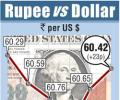
A depreciating rupee, which briefly hit 80 to the dollar on Tuesday, may boost India's exports but price-inelastic imports of crude oil and gold would mean limited relief on the trade deficit, which clocked a record $26.2 billion in June. Due to global risk aversion on the back of geo-political tensions and aggressive policy tightening by the Fed, the dollar has appreciated against most currencies, including the rupee. And, with other currencies depreciating, India's comparative advantage in this respect may be limited.

Gold retains gains, gain nearly 3 per cent in the past three sessions.

Commodity investments can help you diversify your portfolio in asset classes other than equity and debt, says Dwaipayan Bose.

The re-opening of the Chinese economy, as it moves away from its zero-Covid policy, could help stabilise commodity prices, according to some of the country's top metal companies. They view this as a positive for demand, at a time when markets such as the US and Europe have been largely weighed down by slowdown concern now. "Most of us in the metals business are hoping the Chinese economy picks up because half of any metal demand, including demand for aluminium, comes from China.

Continuing its heavy selling spree for the eighth consecutive month, foreign investors pulled out nearly Rs 40,000 crore from the Indian equity market in May on fears of an aggressive rate hike by US Federal Reserve that dented investor sentiments. With this, net outflow by foreign portfolio investors (FPIs) from equities reached at Rs 1.69 lakh crore so far in 2022, data with depositories showed. Going ahead, FPI flows will remain volatile in the emerging markets on account of rising geo-political risk, rising inflation, tightening of monetary policy by central banks, among others, Shrikant Chouhan, Head - Equity Research (Retail), Kotak Securities said.

For the Stalin government to win back the confidence of voters ahead of the Lok Sabha polls, post-flooding restoration works, their speed and efficacy would be closely watched, and not just by the political Opposition, notes N Sathiya Moorthy.

The markets stayed on edge last week due to the endless saga of Greece's problems.

From the Sensex pack, Tata Motors, Sun Pharma, Wipro, Tata Consultancy Services, UltraTech Cement, Tech Mahindra, Bajaj Finserv, HCL Technologies, Infosys and IndusInd Bank were the major laggards. NTPC, Power Grid, Reliance Industries, Tata Steel, HDFC and HDFC Bank were the major winners.

Gold slipped to near 5-1/2-year lows on Friday and was on course for a sixth straight weekly fall.

The Indian rupee is expected to trade between 80 and 84 against dollar in the first three months of 2023 with support from overseas inflows though worsening current account deficit (CAD) and reduced interest rate differential between the US and India pose challenges. According to a Business Standard Poll of 10 participants, most said the rupee could gain strength in January due to foreign inflows, and the Reserve Bank of India (RBI) is not expected to allow the currency to depreciate ahead of the Union Budget scheduled on February 1. The rupee depreciated 10.15 per cent in 2022, its worst performance since 2013 as the war in Europe and the interest rate increase by the US Federal Reserve prompted investors to flee emerging markets.

'New record for the Nifty50 is only a question of when.'

Fitch Ratings on Tuesday retained India's economic growth forecast at 7 per cent for the current fiscal, but cut projections for the next two financial years saying the country is not impervious to global developments. In its December edition of the Global Economic Outlook, Fitch projected India's GDP to grow at 7 per cent in the current fiscal, at a slower rate of 6.2 per cent in 2023-24 and at 6.9 per cent in 2024-25. In September, Fitch projected 7 per cent growth for the current fiscal, followed by 6.7 per cent in 2023-24 and 7.1 per cent growth in 2024-25.

Finance Minister Nirmala Sitharaman on Wednesday said the country's economic growth remains a priority for the government, as inflation has come down to a manageable level. Job creation and equitable distribution of wealth remain the other focus areas, she said at India Ideas Summit. "Some of course are red-lettered (priorities), some may not be. Red-lettered ones would of course be jobs, equitable wealth distribution and making sure India is moving on the path of growth.
In the latest large opinion poll, the opposition Bharatiya Janata Party and its allies were forecast to win a narrow majority in the 543-seat lower house of parliament, compared with previous surveys predicting that they would fall short.

Investors' wealth tumbled over Rs 5.78 lakh crore in two days of market fall amid a weak trend in global markets after a host of central banks hiked interest rates and gave hawkish commentary. The 30-share BSE Sensex declined 461.22 points or 0.75 per cent to settle at 61,337.81 on Friday. In the previous trade, the BSE benchmark had tanked 878.88 points or 1.40 per cent to settle at 61,799.03.

The Reserve Bank of India kept interest rates on hold at 7.50 per cent.

'Hope they don't tinker around with capital gains tax in any way.'

Markets are assuming that by the second half of 2021, the world will be approaching some type of normalcy, points out Akash Prakash.

India's economy is projected to slow to 6.5 per cent in the fiscal year starting April but will remain the fastest growing major economy in the world as it fared better in dealing with the extraordinary set of challenges the globe has faced, the Economic Survey 2022-23 said on Tuesday. India's gross domestic product (GDP) growth of 6.5 per cent in 2023-24 compares with an estimated 7 per cent expansion in current fiscal year (April 2022 to March 2023) and 8.7 per cent in the previous year. Like the rest of the world, India too faced an extraordinary set of challenges in tightening financial conditions and supply chain disruptions from a prolonged war in Europe but "withstood them better than most economies", the annual document detailing the state of the economy said.
'A soft landing of the Indian economy would be a long-term positive for the equity markets.'

The market breadth has turned sharply positive since May amid hopes that a decline in Covid-19 infections will lead to a revival in the economy. At 3.8, the advance-decline ratio (ADR) for May was the best since June 2020. So far this month, the ratio has remained above three - in simpler words, for every declining stock, there were nearly four advancing stocks in May and three this month. ADR is a popular market breadth indicator, with a ratio of more than two signalling an extremely bullish undercurrent.

The 30-share Sensex closed at 27,112 up by 481 points whereas the Nifty ended higher by 139 points at 8,115.

As markets complete the first half of the calendar year 2022 (CY22) with a fall of around 9 per cent, the interest-rate hike trajectory by global central banks, paired with the conundrum of inflation and growth, will move the needle for the market, observe experts. Here's a quick rundown on what they'll react to over the next six months.

RBI Governor flayed easy monetary policy of central banks in advanced economies saying it is "more cause than medicine".

Market breadth depicted gains with 1,476 advances over 1,403 declines on the BSE. 140 stocks remained unchanged.

The S&P BSE Sensex gained 57 points to end at 26,064 and the Nifty50 climbed 17 points.

Indian rupee is likely to test 76-76.50 levels as a relatively strong greenback, boiling crude prices and COVID headwinds deepen the depreciation bias for the domestic currency, according to experts. One of the significantly-hit Asian currency in recent months amid uncertain economic times, rupee is expected to see a consolidation in the vicinity of the current level before being pulled towards the depreciation bias. While the equity market has been surging with occasional blips, the rupee has mostly been weak against the US dollar in recent months.

ITC, Sun Pharma, Maruti, M&M, Tata Motors, HCL Tech, Wipro, Infosys, HUL, Bharti Airtel and Reliance were among the major losers. Kotak Bank rose the most by 1.59 per cent, followed by IndusInd Bank, Bajaj Finance and Bajaj Finserv. L&T, SBI, TCS and HDFC Bank also closed higher.

Infosys was the top gainer in the Sensex pack, rising over 2 per cent, followed by Bajaj Finance, HCL Tech, Tata Steel, Tech Mahindra and NTPC. On the other hand, Maruti, Sun Pharma, HUL and ITC were among the laggards. Nifty rose 122.15 points to 17,343.55.

Brokerage Edelweiss Securities said if the NDA returns to power with a clear majority in line with exit polls, markets would rejoice the policy continuity.

Tech Mahindra, the top loser in the Sensex pack, shed over 2.5 per cent. It was followed by UltraTech Cement, Reliance Industries, HCL Tech, HDFC, Kotak Bank, HDFC Bank and TCS. NSE Nifty plunged 179.35 points to 17,745.90.
Financials were the top gainers lead by private lenders ICICI Bank and HDFC Bank

Probably 35 bps. There could be even an encore in February 2023 to take the policy rate to 6.5% before the financial year ends, predicts Tamal Bandyopadhyay.

Half the stocks in the Nifty 100 index have seen a reduction in their target price by analysts this year due to fears of lacklustre earnings growth and uncertain economic environment. Adani Green Energy, FSN E-Commerce (Nykaa), Adani Ports & SEZ and Indus Towers are among the companies that have seen the maximum cut in TPs during the first three months of calendar 2023, shows Bloomberg data. On the other hand, Canara Bank, JSW Steel and Bank of Baroda have seen the highest increase in TPs.
 © 2026 Rediff.com - Advertise with us - Disclaimer - Privacy Policy - Sitemap - Feedback - About us - Terms of use - Grievances